E-Bike Battery 101 + 10 Safe Charging Tips
‘Man dies in house fire caused by e-bike battery’, ‘Four e-scooter battery fires in 12 hours’, ‘E-bike fires prompt train ban’. A tiny sample of the hundreds of headlines surrounding one of the biggest issues ever to face riders and the global cycling industry – the safety of e-bike batteries.
The problem boils down to quality, cost, and the ever-increasing demand for smarter mobility solutions, and particularly e-bikes.
E-bike sales have surged over the past decade, and with global unit sales projected to reach 50 million by 2030 from 3.7 million in 2020. Here in Australia, the five years between 2017 and 2022 saw sales rise from 9000 to more than 100,000 per year. That figure rose 45% in 2024, and an estimated 220,000 new bikes were sold in Australia in 2025. These numbers make e-bikes the most popular electric vehicle in the country, but also the most maligned.
With such a strong demand for e-bikes, electric motors and batteries, more and more manufacturers have entered the market. And yes, as you have no doubt already realised, many unscrupulous players are cashing in on the boom.
Authorities are beginning to regulate e-bike safety, with the New South Wales state government a prime example, having recently introduced legislation.
“From 1 February 2026, declared e-micromobility devices and batteries must be tested, certified and marked prior to sale in NSW. Chargers must already be tested, certified and marked,” states the state’s Office of Fair Trading website.
“NSW Fair Trading has published a register of certified products to assist retailers, hire businesses and consumers in identifying approved products. This register will be updated regularly, as vehicle and battery models are certified,” it says.
“Fair Trading may take enforcement action against non-compliance and penalties of up to $825,000 may apply for breach of the Product Safety Standards.”
Buy Right At The Start
From budget shoes to bargain airline tickets, the pattern is the same – price and quality almost always move in opposite directions.
And e-bikes are no exception: cheap, cheerful brands or batteries typically don’t perform anywhere near their stated claims and will deteriorate quickly. Additionally, many of these bikes are illegal because they are not pedal-assist and effectively have a throttle lever.
Focusing on batteries, manufacturers tend to use minimal and low-quality material for electrical connections between cells. Additionally, they’re not mechanically well-built, which isn’t a huge deal for a desktop computer backup battery that just sits there, but for something you’re going to be rattling or bashing around, it’s important. A sub-standard battery pack is likely just held together with hot glue and a single layer of shrink wrap.
A better-quality battery starts with higher-quality cells, which can easily double the cost per cell. For a 20Ah pack, you could be talking 78 linked cells, which cost $2 to $4 each. The electrical connections are a thick, full nickel strip, not thin nickel-plated steel, and some even have a copper bus bar with individual fuses linking to each cell.

Quality cells are contained in a plastic or fibreglass framework, wrapped in several layers of thick rubber-like material or, in some cases, completely covered in a hard epoxy set in an alloy or plastic case.
A reputable and legal e-bike has far less chance of catching fire – the vast majority of e-bike fires occur through non-compliant batteries and chargers.
During a trip to China, a highlight was visiting two major battery cell factories, including one of the world’s leading lithium-ion battery cell manufacturers, Phylion.
Making Battery Cells
The company Ride On visited produces 200,000 battery units per day, cells that power bikes from major global brands.
Spending time at two factories – and seeing first-hand how a giant bunker bag of raw lithium plus an enormous roll of copper foil sheeting are ultimately morphed into thousands of world-class e-bike batteries – was an eye-opening experience.

At the first location, we witnessed the complete production line process – raw materials being blended into a slurry and thinly and precisely applied to copper foil using high-volume automated production lines.
The process is tightly sealed to prevent contamination, improving energy density and consistency. Prior to entering different sections, we had to be fitted with anti-static gowns, wear face masks and pass through various anti-static discharge rooms.
We watched on in awe as die-cutting machines sliced millimetre-perfect electrode sheets – the whole production process undertaken with surgical precision.
Moisture was another factor heavily controlled – sealed lamination and state-of-the-art formation processes further protecting the cells from potentially problematic environmental factors. Nothing is left to chance in this factory; attention to detail is second to none, pass rates in the endless testing are over 99.9%, and the facility runs like clockwork.
Along with the assembly lines and production facilities, the test centre was the highlight of the two-day visit, where bikes from numerous major mainstream brands were tested both statically and in real life.
Testing, testing …
The level of stringent testing and quality control was astounding and reassuring, particularly given the rise and rise of e-bike hysteria.
The focus and concentration of those working right across the production line – from guiding that initial bulker bag of raw lithium through to technicians with oscilloscopes checking and re-checking batteries – was phenomenal.
Charge Discharge Cycle Testing
All batteries produced at the Phylion factory are charged, discharged, and then recharged. Random sample batteries are regularly removed from the charge racks for testing.
The Overcharge Test
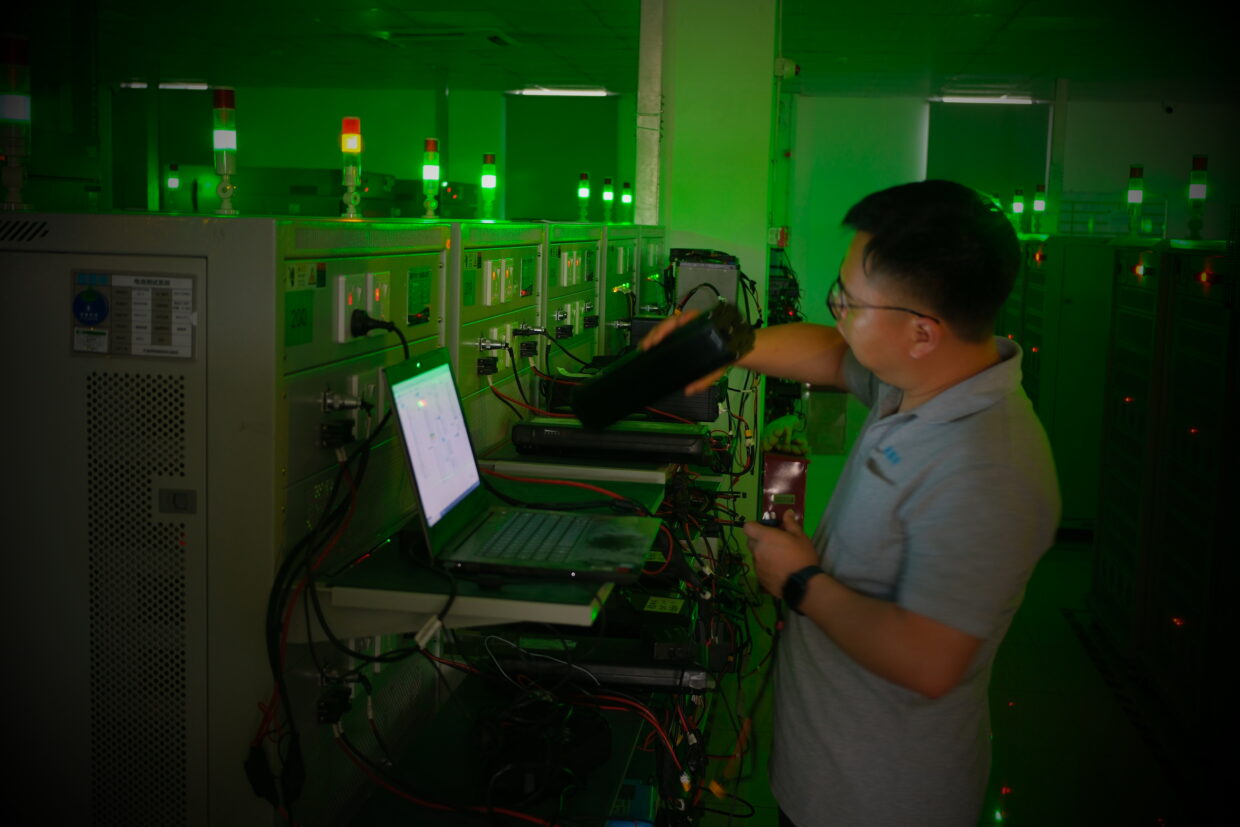
E-bike batteries are put on a special test charger, where they are given a standard charge, then a double, and then a near-triple charge. This is one of the major issues with lesser-quality batteries and chargers—and a likely cause of thermal runaway and a potential fire. A high-quality Battery Management System is key here, and we watched as the BMS, which was monitored and live-logged on a nearby laptop, automatically cut power.
The Pierce Test
A fully charged battery is placed in a jig, a button is pressed, and then a 6-inch steel pin is hydraulically driven through the battery. Straight through the positive and negative plates, but without shorting the battery.
The Drop Test
Rising to a metre above a concrete floor, a test machine releases the e-bike battery, where it drops to the floor. We watched on as a battery was put through this hellish cycle three times – to no ill effect other than a few marks and scratches.
The Full Immersion Test
A fully charged battery was secured to a line and then submerged in a test tank. After being placed in more than a metre of water for half an hour, the battery was removed, lightly dried, and inserted into a test bike.
10 E-Bike Battery Safety Tips
1 Start smart – while it’s possible to order the parts and build up an e-bike from a kit, this is where risk and problems begin. After an e-bike? Great! Buy from a reputable source that has developed a system-wide solution, rather than simply combining parts of dubious origins.
2 Ensure that the battery and charger are compatible. Avoid using a generic battery charger for your smart battery as it can cause damage.
3 Charge the battery on a hard, flat surface where it won’t be knocked over, and keep the charge area clear of combustible materials.
4 If possible, remove the battery from the bike to charge it.
5 Check your batteries from time to time. Inspecting the outer casing, connections etc for damage or wear.
6 Don’t leave a battery on charge for longer than necessary. If you don’t need to fully charge a battery, don’t. Batteries have a longer life and offer better efficiency when charged to 80 to 90%.
7 Try not to totally drain a battery, and keep some charge if you’re not using the bike for a while.
8 If you have any suspicion about a battery, don’t charge it.
9 If the battery feels excessively warm while in use, appears swollen, or the casing is bowed out, or even if there is a hint of an electrical smell, don’t charge it. These are indicators of internal damage, and the battery should be returned to the place of purchase or the manufacturer.
10 Consider investing in a ‘charging bag’ to help mitigate heat buildup and prevent combustion – a large hardware chain sells them.